
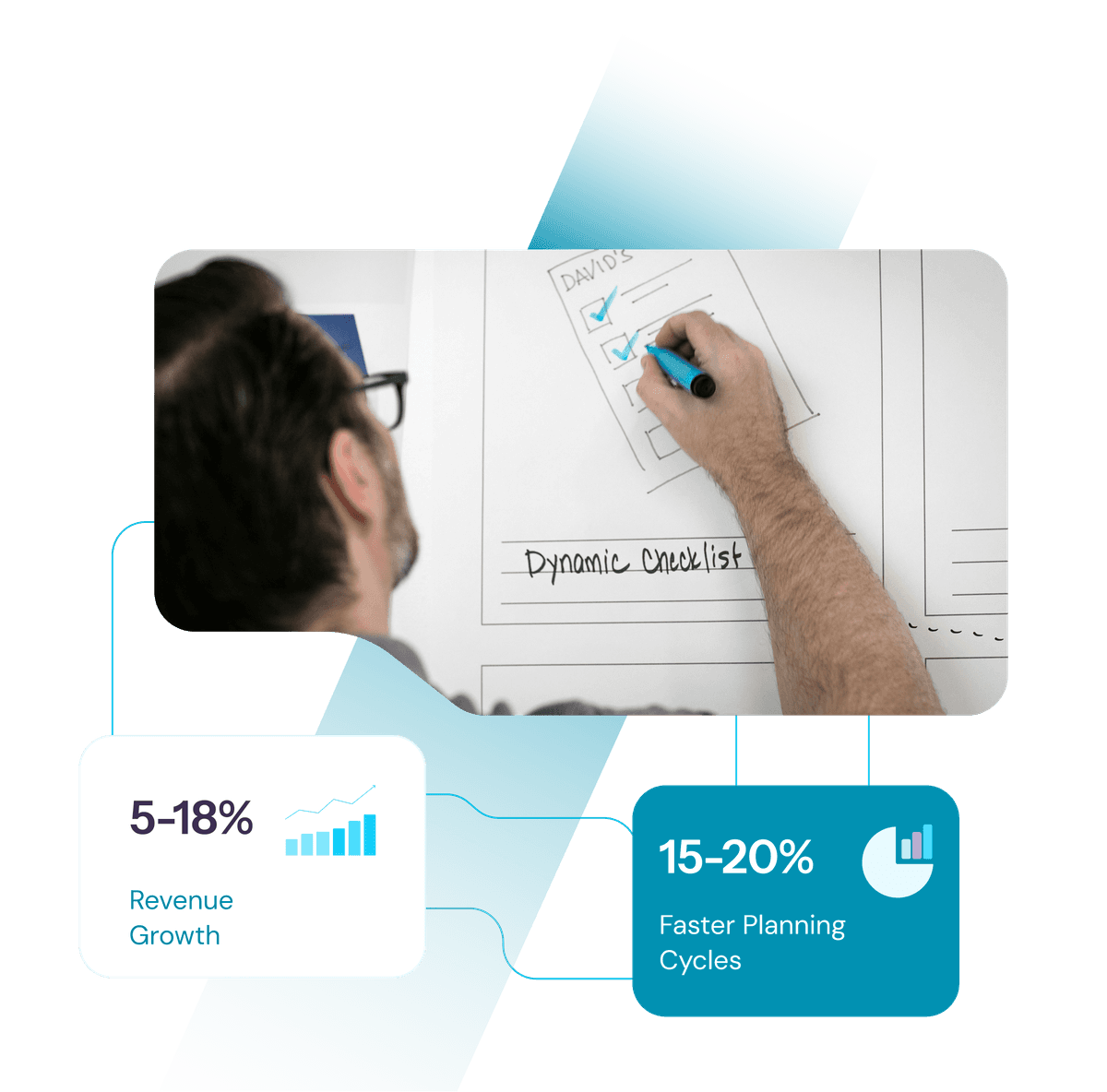
0–18%
Revenue Growth

Across pricing, demand planning, marketing and customer strategy, stronger analytical models improve not only what teams know, but how precisely they allocate money, inventory and effort.
Demand shifts, price changes, customer behavior and marketing performance rarely move independently. The challenge is understanding these signals together, early enough to make a better call.
Forecast demand across products, markets and channels by bringing together historical performance, seasonality, promotions, market conditions and external variables. The result is a clearer basis for inventory, production and commercial planning.

Next Best Action models combine customer behavior, purchase history and contextual information to recommend the most relevant action across sales and marketing touchpoints.
Move beyond broad segments by combining behavioral, demographic, psychographic and transactional signals. Clustering and micro-segmentation reveal meaningful differences in customer needs, value and propensity to respond.
Understand the relationship between price, elasticity, promotions, product mix and trade investment. Scenario modelling helps teams evaluate the volume-versus-value trade-offs behind revenue and margin decisions.
Quantify how channels contribute to sales, compare returns across investments and simulate alternative budget allocations using Marketing Mix Modeling and optimization techniques.
A connected set of analytical capabilities spanning forecasting, commercial strategy, customer intelligence and performance measurement, built around the questions businesses need to answer.

The right price at the right moment turns demand into margin without eroding trust.

Trade and promo dollars only work when every lever is aligned to the same growth story.

Attribution that ignores long arcs and offline effects quietly misallocates millions every quarter.

RGM breaks when pricing, assortment, and promo strategies are optimized in silos.

Relevance at scale demands segmentation that evolves as fast as customers do.

Forecast error is not a spreadsheet problem - it is a service-level, cash, and credibility problem.
The strongest analytical solution is not always the most complex one. It is the one that reflects the business context, fits the available data and gives teams something they can confidently use.
The starting point is the decision that needs to improve, not a predetermined algorithm. Business objectives, available data and measurable outcomes shape the analytical approach from the beginning.
Solutions are designed around the organization's goals, infrastructure and data landscape rather than forcing a standard model or analytical framework onto every problem.
Pricing, promotions, demand, customers and channels influence one another. Bringing these signals together gives teams a more complete basis for commercial and planning decisions rather than optimizing each lever in isolation.
Models become more useful when teams can test the implications of a decision before making it. Scenario simulation across pricing, marketing investment, promotions and channel strategies brings analytical evidence into planning conversations.
Analytics should not end with a model output. Recommendations, predictive signals and performance views are integrated into the workflows where commercial, marketing and planning teams already make decisions.
End-to-end visibility across model design, development and deployment keeps the analytical process understandable and gives internal teams greater confidence in how decisions are being supported.
Agentic workflows can take on more of the repetitive work across discovery, data preparation, modelling and monitoring, while data scientists remain in control of the decisions that require business and analytical judgment.
Frame the Problem
Interprets the business objective, breaks it into analytical tasks and determines the sequence of work required across data, modelling and validation.
Find the Right Signals
Explores available data, identifies relevant variables and relationships, profiles quality and builds the context required for analysis.
Prepare Data for Modelling
Coordinates data preparation and transformation workflows, executes repeatable pipelines and surfaces issues that could affect downstream model performance.
Experiment, Compare and Refine
Supports model selection, feature development, training and comparison across candidate approaches, accelerating experimentation without removing expert review.
Keep Models Useful in Production
Moves validated models into the operating environment and tracks performance as new data arrives, helping identify when changing conditions require investigation or refinement.
From pricing and demand planning to marketing effectiveness and personalization, see how advanced analytics and machine learning improve the decisions behind growth.

An integrated analytical framework brings pricing, promotions, product mix and trade investment together to identify revenue leakage, model commercial trade-offs and give teams a common view of the levers influencing growth.

Machine learning models combine historical demand with market signals, seasonality, promotions and external variables to improve forecast precision and support inventory, production and replenishment decisions.

Machine learning and NLP use engagement history, sentiment and contextual signals to adapt content across digital touchpoints, while recommendation systems improve relevance throughout the customer journey.
Perspectives on the analytical methods, business questions and emerging approaches changing how enterprises forecast, optimize and make decisions with data.
Subscribe for the latest on AI-driven commercial solutions and enterprise insights.
Whatever you're trying to figure out, we'd love to hear about it and show you how we can help.